6 Reasons Why Your Website Should Have a Blog

A 2014-2015 study by HubSpot found that companies that blog are 13 times more likely to generate a positive marketing ROI.

If you want to increase the visibility and credibility of your company to consumers, you should consider regularly posting quality content on your website that will be interesting and useful to them. A blog is where this content should be housed, whether or not you call this section of your website a blog. On many sites, the “blog” has a different label, such as News, Press or Articles.

1. Drive Traffic to Your Website

In addition to the ROI a website with a blog can generate, websites with blogs may be able to get more traffic than websites without blogs. So how do blogs drive all this additional traffic?

Good SEO results are largely driven by new content and relevant keywords, so not only do you need fresh content, you also need a place to house it. Blogs provide you with the platform to do just that: adding fresh content to your website gets it placed higher in search engine results than other websites, which makes it more likely to get clicked.

2. Convert Traffic Into Leads

Now that your website is getting more traffic, you have the opportunity to convert that traffic into leads. Each new piece of content gives you the opportunity to generate leads, and the way to do that may be by adding a call-to-action to each blog post. Try offering something that consumers will give up their contact information for, such as a free e-book, free webinar, free consultation or quote. Once you have their contact information, your sales team can follow up with those leads.

3. Become an Authority in Your Industry

The best small-business blogs can answer potential customers’ common questions and discuss industry trends. If potential customers view your blog as one that can provide helpful information about relevant topics, they may be more likely to do business with you than with your competitors. Interesting and unique content can also give you the opportunity to drive traffic to your website through inbound links. In fact, the Hubspot report found that websites with blogs have 434 percent more indexed pages than websites without blogs.

4. Build Relationships With Potential Customers

The comments section on your blog is the place on a website where you can have a two-way discussion with consumers. Encouraging engagement on your blog can be as simple as asking questions at the end of a post to get the conversation going, waiting for readers to leave comments and then interacting with those readers. By responding to your readers’ comments, you have the opportunity to build trust and gain insight into what your customers are looking for.

5. Give Your Social Media Efforts an Added Boost

Blog content can be perfect for sharing on social media. When you create original content that’s valuable, interesting and entertaining to your target demographic, you can be more likely to get social shares. An added benefit: Unlike posting curated content on your social channels, content that’s shared from your blog will point directly back to your website.

You can also add social sharing buttons to your blog so visitors can easily share your content—turning your readers into your own grassroots marketing team.

6. Drive Long-Term Results

So you write a post on your blog, promote it on your social channels and hopefully get some shares. After that initial flurry of activity, the traffic driven by that post will slow to a trickle. And that’s the end of that, right?

Not by a long shot. That page is now ranked in search engines. Just like the rest of the static pages on your website, this blog may continue to be visited as long as it’s on the Web. In fact, a website with a substantial amount of blog content can continue to boost total traffic from old blog posts, providing the potential of a pretty substantial return on the few hours you invested in writing a post.

From a practical standpoint, adding a blog to your business website may just make sense. With minimal expense and effort, you can boost search engine rankings, build credibility, increase website traffic and foster relationships with customers. This, in turn, can make your readers more likely to hire you or purchase products from your company, in addition to recommending your business to others.

Courtesy S. Rand
Google made a giant change today that could effect your businesses

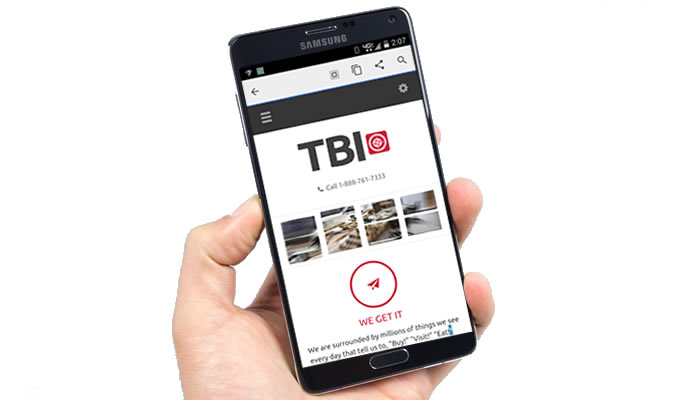
Today Google is making a major update to its mobile search algorithm that will change the order in which websites are ranked when users search for something from their phone.

The algorithm will start favoring mobile-friendly websites (ones with large text, easy-to-click links, and that resize or are “responsive” to fit whatever screen they’re viewed on) and ranking them higher in search. Websites that aren’t mobile-friendly will get demoted.

About 60% of online traffic now comes from mobile and Google wants users to have a good experience whenever they click on a mobile link.

Overall as many as 40% of top websites are not currently mobile friendly.

This mobile friendly test will let you know if your site is up to date or will warn you if you need work (not mobile friendly).

https://www.google.com/webmasters/tools/mobile-friendly/

About TBI

TBI is a forward-thinking performance marketing agency focused on igniting the connection between brands and their consumers.

As individuals we are designers, strategists, writers, artists, art directors, techies, sales people, market analysts, media gurus, entrepreneurs, and inventors. As a collective we are much more.

Invest in a Great Website

You just worked your rear end off for the last 12 months.

Creating your product. Having samples made. Ordering 1 million of them because that’s the factory’s minimum.

You had someone in Indonesia create a slick logo for you. You set up your UPS account. You’ve rolled up your sleeves and you’re ready to get started on your ecommerce website.

Maybe you know a guy who’s nephew builds websites from his dorm. Or you read some article on how to build your own website in three easy steps. So now all you have to do is get the website built and you’re good to go, right?

Wrong.

Over the years, I have met too many start-ups trying to build their own websites and too many entrepreneurs whining about the price to build a great website. And it bugs me.

Building a beautifully designed, fully capable website is no longer a luxury if you’re looking to launch or grow any ecommerce business in 2015. It’s a necessity.

Look, I get it. You’re a startup. You have a limited budget. You’re an entrepreneur willing to do things yourself. And that’s all very admirable. But if you’re launching an ecommerce business and you’re unwilling to invest in your website, then you’re better off having never launched your business.

Here’s why.

You have a single presence. Make it count.

Instead of a website, let’s assume instead you’re opening a new brick-and-mortar clothing store. Since you’re a startup, your shop would likely be small. Your budget for build-out wouldn’t be much. But at a minimum, you still have to pay for paint, flooring, lights, shelves, displays, mannequins, a POS system, an inventory system and quite a few fixtures. Even with just a short one-year lease for retail space, no matter where you open it, you’d still be looking at $100,000 to cover just your physical presence. Probably more.

And even after dropping $100,000, you’d still pale in comparison to the Bass Pro Shop down the road from you. Or the Dicks Sporting Goods. Or any other competition that is already selling online. They’d kill you in presentation, assortment and skilled labor. You’d never survive.

But…if you’re building an ecommerce website, customers view you differently. They view you only in the narrow world of online space. They won’t be thinking about what the Macy’s store in their neighborhood looks like. They’ll compare cabelas.com with your website.

And guess what? Now you have a much better chance in this competition.

While the cost of a good web developer varies, a beautifully designed, fully capable website should cost between $7,000 and $20,000 at most. Now compare that with the $100,000 you’d spend for your brick-and-mortar store — and you’d still lose that battle in every way. So why wouldn’t you spend a few bucks and build a kick-ass website? A website, by the way, that would last far more than a year.

So what does it mean to have a beautifully designed, fully capable website?

The best place to start when designing your website (both aesthetically and as a utility) is to roam the web seeking out your competitors. What do their sites look like? What do you like most about their design? What do you like least about their design?

Now start looking at sites outside of your competition. Look for anything from a design perspective that appears fresh or unique. I’m building a website now to sell bar products. Our gallery of thumbnails and product pages were inspired by a website I found dedicated to all those “fund me” sites that are so popular. A totally different industry, and yet, the design scheme fit perfectly for what I wanted to do.

So after you have the design figured out, then make sure your product photos are professionally taken. Every piece of research I’ve ever read confirms that the nicer your product photography, the higher the conversion rate. And of course, the lower the return rate of your products. Poor photography also intangibly affects your brand. Do yourself a favor and hire a professional photographer.

Now it is time to revisit your competitors and test their navigability. Pretend you’re the consumer. Do the categories make sense? Are there any special features that you love? Is there something you hate? Do you wish it had a certain feature to bridge the gap between shopping in-person vs. shopping online?

So when building your website, make sure to include the features you love and exclude the features you don’t. And if you can come up with a creative add-on to your site, all the better.

Mobile

I will not bore you with the stats (which are everywhere) but suffice it to say that if your website does not translate well into an easy and appealing mobile experience, you’re wasting your time investing in your new beautifully-designed, fully capable website.

About TBI

TBI is a forward-thinking performance marketing agency focused on igniting the connection between brands and their consumers.

As individuals we are designers, strategists, writers, artists, art directors, techies, sales people, market analysts, media gurus, entrepreneurs, and inventors. As a collective we are much more. #design #branding #web

Gregg Shuggar Contributor

The Most Important Change You Can Make to Prepare for 2020

If you’re in business today, it’s critical to become a visionary. Leaders who fail to anticipate the trends that will transform business down the road put themselves at a distinct disadvantage–one that could eventually become fatal for the company. Yet with the rapid-fire pace of constant change taking place in relation to work, innovation, and leadership, how can you be sure that you’re zeroing in on the trends that really matter to your company’s future?

Begin by looking for the emergence of common denominators. What do the most successful companies have in common? What are they doing differently to command greater market share than their competitors? With these questions in mind, though I don’t have a crystal ball, I can make some confident predictions about what organizations can do today to pave the way for 2020.

To start, a key way leaders can help their organizations plan for the changes in store is to learn how to embrace culture as a strategic competitive advantage. Companies that do so will be positioned to reap a number of distinct benefits. Here are three of the biggest ones:

Increased productivity

Over the next five years and beyond, more and more companies will become tech-centric–either relying on technology as an enabler or a driver of their core business. As Silicon Valley has shown us, a vibrant, deliberate culture is the common denominator among tech’s most innovative companies, from Google and Facebook to Twitter, LinkedIn, and Airbnb. The top tech firms have achieved a level of success that few companies have managed yet to replicate.

That’s because people work differently at the tech giants, in large part through their commitment to fostering a different type of work environment. Pluralsight recently toured a number of these firms, and we were blown away by the awesomeness of their cultures. On the surface, you see teams working in transparent, high-tech spaces while sharing meals in gourmet cafeterias, taking onsite yoga classes, and in some cases transporting between floors on giant office slides.

But behind the scenes, there’s a method to the madness. These special work environments–which provide employees with a setting that can feel more like after-hours than an office–do not lead people to get less work done, as might be expected. Instead, by creating a culture where people not only want to come to work but even enjoy staying past 5pm, the top companies attract talented tech-savvy Millennialswhile boosting productivity. When employees can take care of personal business on the job–like using an onsite laundry service or visiting a staff doctor or dentist–it’s easier for them to concentrate on crunching through that last-minute project, even if it means staying a little later.

Higher innovation flow

Workplace culture can also nurture creativity and fuel innovation. Companies that embrace culture as a strategic advantage ensure that more time will be spent on problem-solving than on negotiating cultural barriers. Creating an in-house setting like those described above helps ensure that employees will be empowered to innovate in a no-fear culture, with less political and bureaucratic overhead. Nothing quashes a company’s creativity engine faster than a culture where fear leads to poor communication, office politics, and disengagement.

These insights aren’t just speculation; they’ve been validated by research. The Bay Area Council Economic Institute found that the firms in Silicon Valley–with their especially employee-friendly cultural settings–are nearly four times more likely to align their innovation strategy with their overall business strategy, compared with non-Valley firms. Additional research from Booz & Allen found that the free-spirited cultures of Valley firms have more than double the likelihood of non-Valley firms to be tapped into the organization’s innovation strategy.

Easier recruiting, better retention

An awesome work culture is a magnet that brings the best talent to you instead of your competitors. Companies that have a reputation for prioritizing workplace culture have a much easier time with recruitment, as people want to participate in such organizations. Not only does culture facilitate recruiting by minimizing the need to search for talent, but it also saves money that would otherwise be required to get the best people in the door through large-scale recruitment efforts. The right work environment additionally makes it much easier to keep the best people. When employees are inspired by the culture, the mission, and the people they work with, they won’t want to go anywhere else.

Culture truly is a competitive advantage–in more ways than one. Creating a deliberate culture can play a major role in aligning employees with the company’s larger goals, encouraging intrinsic motivation to work toward a shared vision of where you’re all trying to go as an organization. This not only stokes a company’s productivity engine, but also helps ensure a continuous pipeline of fresh ideas–and long-range talent–to keep your business competitive. I would personally invest in companies with strong cultures over those that don’t, because as Patrick Lencioni points out in his book The Advantage, organizations that care about culture are much more likely to be more successful in the long run. It’s not just the latest trend, but a true business advantage that will become even more crystal clear in 2020 and beyond.

What to Consider When Trying to Market on Social Media

If the last decade has shown us anything, it’s that social media is here to stay. As it continues to evolve, it can be difficult for startups and entrepreneurs to determine where to focus their marketing efforts.

While there are certainly many options out there when it comes to social media marketing, there is no need to let your plans become derailed by analysis paralysis. Instead, focus on the following steps to launch a successful social media marketing campaign.

Which social media platforms are best for your brand?

There is often a misconception that in order to make the most of social media marketing, you need to be visible on every outlet. This approach can quickly spell disaster for startups that might already be stretched thin in terms of time and resources. Not all outlets will be relevant to your brand. A better approach is to identify and focus on the outlets that are most relevant and valuable. Social media marketing works best when you can generate a consistent content strategy and maintain an active presence. That can be difficult to accomplish across multiple platforms. In this regard, less is more. Take the time to determine which platforms will be most beneficial and use those as your launching point.

Consistency matters

As previously mentioned, social media marketing works best when it is consistent. This cannot be a hit or miss proposition or you will miss the target entirely. The best way to approach this is with a content posting schedule. There should be no reason why you do not post on your chosen outlets, particularly with a plethora of tools that make it easy for you to schedule and automate posts, such as Sprout Social.

Viral content

The goal of any social media marketing strategy is to attract attention to your brand and engage customers. Any social media marketer’s ultimate dream is to have his or her content go viral, which is not always easy to accomplish. This is particularly true as more content is posted each day and the attention of users becomes divided. Social Media Today points out that content tends to go viral when it meets these three characteristics: it’s unique or exceptional, it appeals to influencers, and it can be easily shared. Content with the ability to go viral should also be engaging to viewers, meaning that it is easy for users to become involved and comment. Not all the content that you produce will go viral, but it is important to aim for that goal by ensuring that each piece of content you produce meets the three characteristics of viral content.

Social media marketing can be challenging, but not so much so that you become overwhelmed to the point that you never even get started. When handled properly, social media truly does have the power to transform and launch any startup. Airbnb is an excellent case in point: the apartment-rental service got its start back in 2007 when its founders could not afford to pay their rent. They converted their loft into a lodging space using air mattresses and launched a website to advertise their space. Since then, however, the company has launched a number of innovative campaigns and social media movements. Today, Airbnb is a global company and a strong candidate for an IPO this year, according to Nasdaq.

By taking the time to develop and stick to a social media marketing plan, your startup has the potential to soar.

Listening: The Forgotten Business Tool for Amazing Success

Listening is one of the most important skills you can have when it comes to business and leadership.

We listen to learn.

We listen to stay informed.

We listen to understand.

We listen to gain information.

We listen to acquire knowledge.

We listen to obtain wisdom.

Given all the listening we do, you would think we would be much better at it.

In fact most of us are lousy listeners; research suggests that we remember only 25 to 50 percent of what we hear.

So when your boss, colleague, customer or spouse is talking to you, you are only truly hearing half of what they are saying–at most.

Being a good listener has significant benefits. It helps build critical relationships with clients, bond with customers, and engage with employees.

This Cheap Flat-Pack Modular Home Won’t Fall Over In A Hurricane

Cheap, wooden, and flat-packed—they’re not characteristics you would normally associate with hurricane-proof housing. But then most hurricane-proof buildings aren’t like the Cubicco, which is now available in Florida.